
Calcium, Collagen and Bone Health: What You Should Know

When people think about keeping their bones strong, calcium is usually the first nutrient that comes to mind. And for good reason: calcium is a major mineral component of bone and an important nutrient for maintaining normal bone health.
But bone is more than just calcium.
Bone is a living tissue made up of both mineral and organic components. Among these organic components, Type 1 collagen forms an important structural framework. This is why interest in collagen for bone health has grown in recent years, particularly as researchers investigate whether collagen peptides consumed as part of the diet may influence bone-related measures such as bone mineral density.
So, how do calcium and collagen differ? What does the research actually tell us about collagen peptides and bone density? And if you are considering a collagen supplement in Singapore, what should you look for?
This article explores the relationship between collagen and bone health, the role of calcium and vitamin D, and where collagen supplementation may fit into a broader approach to maintaining healthy bones.
Important: This article provides general health information and is not intended to diagnose, treat or prevent osteoporosis or any other medical condition. If you have been diagnosed with osteoporosis, osteopenia, low bone mineral density or have concerns about your fracture risk, speak with an appropriately qualified healthcare professional.
Why Is Collagen Relevant to Bone Health?
Collagen is one of the body’s major structural proteins. It is found in skin, tendons, ligaments, cartilage and bone.
In bone, Type 1 collagen forms much of the organic matrix. Minerals such as calcium and phosphorus are deposited within this framework, contributing to the hardness and strength of bone.
This gives us an important way to understand the relationship between calcium and collagen.
Calcium contributes to the mineral component of bone, while collagen contributes to its organic structural framework.
They are therefore not interchangeable nutrients.
This is also why the conversation around calcium and collagen for bones is more nuanced than simply asking which one is “better”. They have different biological roles within bone tissue.
What Is Type 1 Collagen?
There are different types of collagen in the human body, but Type 1 collagen is particularly abundant in bone.
This is why research into Type 1 collagen for bones and hydrolysed collagen peptides has attracted attention.
Hydrolysed collagen, sometimes called collagen peptides, is collagen that has been broken down into smaller peptide fragments. These can be consumed as part of a supplement or functional food.
However, the fact that collagen is naturally present in bone does not by itself prove that consuming collagen will increase bone density.
That question needs to be considered separately — and this is where clinical research becomes important.
Calcium and Collagen for Bones: What Is the Difference?
Calcium and collagen contribute to different aspects of bone structure.
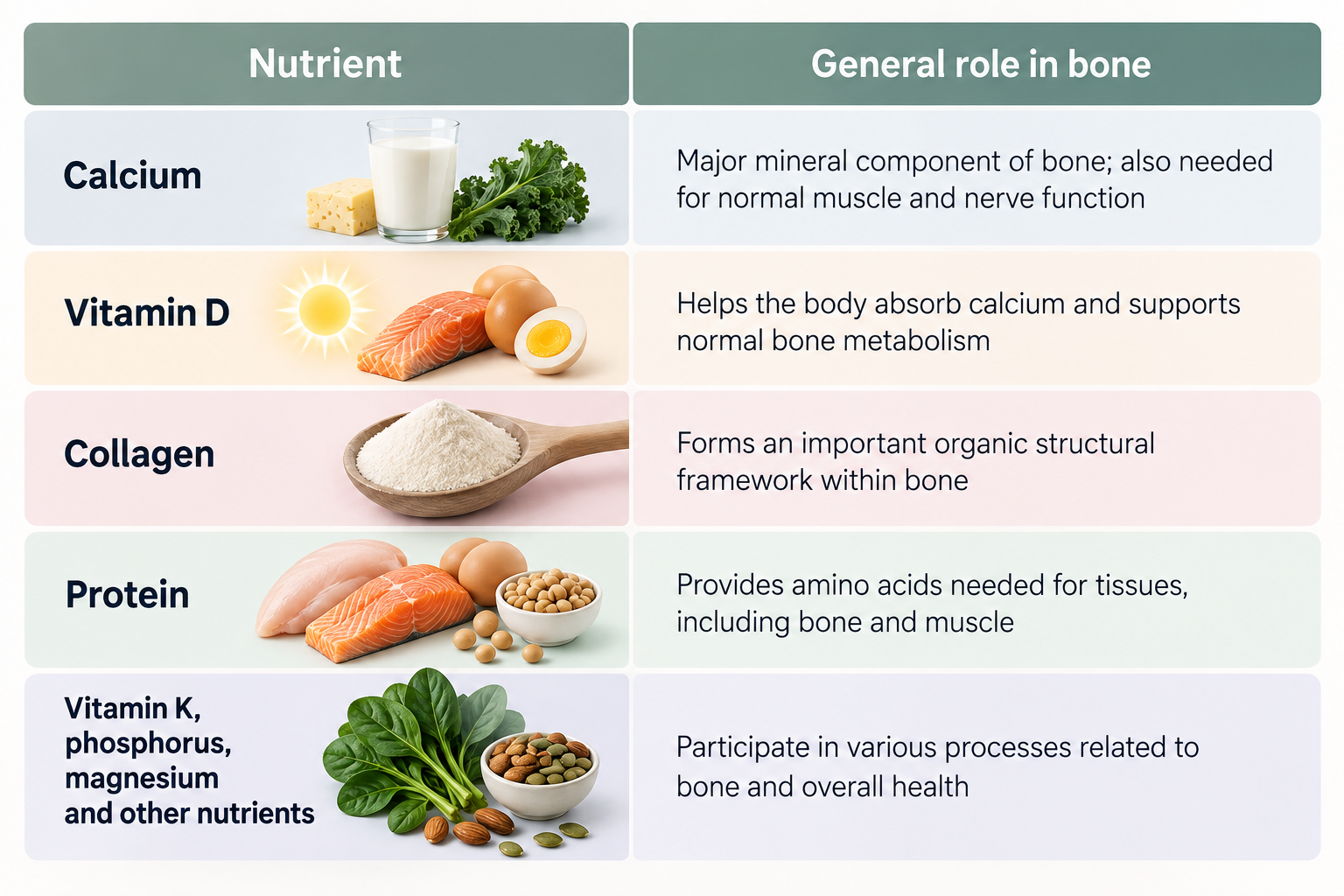
This does not mean that everyone needs to take all of these nutrients as supplements.
For most people, the foundation of bone health is a balanced diet that provides adequate nutrients, regular physical activity and healthy lifestyle habits.
Supplements may be considered when dietary intake is insufficient or when recommended by a healthcare professional.
How Important Is Calcium for Bone Health?

Calcium is essential for normal bone development and maintenance.
According to Singapore’s current Recommended Dietary Allowances, adults aged 19–50 are recommended to consume 800 mg of calcium per day, while adults aged 51 and above are recommended to consume 1,000 mg per day. The recommendation is also 1,000 mg per day during pregnancy and breastfeeding.
These figures refer to total daily intake, not necessarily the amount that needs to come from supplements.
Calcium-Rich Foods
Whenever possible, calcium can be obtained through a varied diet.
Common sources include:
- Milk
- Yoghurt
- Cheese
- Calcium-fortified soy milk
- Calcium-set tofu
- Sardines and other fish eaten with their edible bones
- Ikan bilis
- Some dark green vegetables
- Calcium-fortified foods
For people who do not consume dairy products, fortified soy products, tofu, fish and other calcium-containing foods can provide alternative sources.
The important consideration is whether your overall diet provides sufficient calcium for your individual nutritional needs.
For more information about calcium-rich foods and dietary sources, readers can refer to HealthHub’s guide to daily calcium intake.
Calcium Is Not the Whole Story
It is tempting to think of bone health as simply a matter of consuming enough calcium.
However, healthy bones depend on several factors.
Vitamin D helps the body absorb calcium and plays an important role in normal bone metabolism. Protein provides amino acids needed by bone and muscle. Physical activity provides mechanical loading that helps support bone strength.
Age, hormonal changes, body weight, physical activity, smoking, alcohol intake, certain medications and medical conditions can also influence bone health.
This is why a single nutrient should not be viewed in isolation.
What Does Research Say About Collagen for Bone Health?
This is one of the most interesting areas of collagen research.
Because Type 1 collagen is an important component of bone, researchers have investigated whether consuming collagen peptides could influence bone metabolism or bone mineral density.
Some human studies have reported encouraging findings.
One 12-month randomised controlled trial involving postmenopausal women with age-related reductions in bone mineral density found that daily supplementation with 5 g of specific collagen peptides was associated with increases in bone mineral density at the spine and femoral neck compared with the control group. The study also reported changes in bone turnover markers. View the study on PubMed.
Another randomised study examined collagen peptides together with calcium and vitamin D in postmenopausal women with osteopenia. After 12 months, the collagen group showed favourable changes in certain measures of bone structure and bone mineral density compared with calcium and vitamin D alone. View the study on PubMed.
These findings provide a scientific basis for continued interest in collagen peptides for bone health.
However, they should be interpreted carefully.
What Do These Studies Actually Mean?
The research does not mean that every collagen supplement will increase bone density.
Studies may differ in:
- The type and source of collagen used
- The degree of collagen hydrolysis
- Daily dosage
- Study duration
- Participant characteristics
- Other nutrients provided
- The methods used to measure bone-related outcomes
A systematic review of Type 1 hydrolysed collagen research has also highlighted promising findings while noting limitations and differences between available studies.
Therefore, the current evidence can reasonably be described as promising but still developing.
The research supports the idea that collagen may be relevant to bone health. It does not establish collagen supplementation as a replacement for medical treatment or as a guaranteed way to increase bone density.
Collagen and Bone Density: Is There a Connection?
Some clinical trials have reported improvements in bone mineral density following supplementation with specific collagen peptides, particularly in postmenopausal women.
Bone mineral density, or BMD, is a measurement of the mineral content of bone and is commonly assessed using a DXA scan when clinically indicated.
However, bone density is only one part of assessing bone health.
It is also important to consider factors such as age, previous fractures, family history, medication use and other risk factors.
This distinction matters because:
Collagen supplementation and osteoporosis assessment are not the same thing.
A person cannot determine whether they have osteoporosis simply by looking at their diet, taking collagen or observing whether they experience symptoms.
Does Collagen Treat Osteoporosis?
No — collagen supplements should not be presented as a treatment for osteoporosis.
Osteoporosis is a medical condition characterised by reduced bone strength and increased susceptibility to fractures. It requires appropriate clinical assessment and, where indicated, medical management.
Singapore’s Ministry of Health guidance states that osteoporosis should be diagnosed using appropriate assessment, including DXA of the hip and spine and/or a previous fragility fracture. View the MOH clinical guidance.
Collagen research may be relevant to the broader scientific discussion about bone health, but it does not mean that collagen can replace prescribed osteoporosis medication or clinical care.
If you have been diagnosed with osteoporosis or have a high risk of fracture, speak to your doctor about appropriate assessment and treatment.
This is particularly important because osteoporosis may progress without obvious symptoms. HealthHub describes osteoporosis as a condition that can be “silent” in its early stages, with fractures sometimes being the first indication that bone strength has been significantly affected. Learn more from HealthHub.
Could Collagen Be Part of a Broader Bone-Health Strategy?
Potentially.
Rather than viewing collagen as a standalone solution, it may be more useful to think about bone health as a combination of nutritional and lifestyle factors.
These may include:
Adequate Calcium
Ensure that your diet provides an appropriate amount of calcium for your age and individual needs.
Adequate Vitamin D
Vitamin D helps with calcium absorption and contributes to normal bone metabolism.
Sufficient Protein
Protein provides amino acids required by many tissues, including bone and muscle.
Regular Physical Activity
Weight-bearing and resistance exercises can place appropriate mechanical demands on bones and help support muscle strength and physical function.
Healthy Lifestyle Habits
Not smoking and limiting excessive alcohol intake are also part of maintaining overall bone health.
Appropriate Nutritional Support
For individuals whose dietary intake does not adequately meet their nutritional needs, supplementation may sometimes be considered.
This is where collagen supplements may fit into an individual’s overall nutritional routine.
What Should You Look For in a Collagen Supplement?
If you are searching for a collagen supplement in Singapore, it is useful to look beyond the word “collagen” on the packaging.
1. Consider the Type of Collagen
Bone contains predominantly Type 1 collagen, which is why Type 1 collagen and collagen peptides have been investigated in bone-related research.
However, the type of collagen, source and processing method can differ between products.
2. Consider the Collagen Peptide Content
Research studies have used different collagen preparations and amounts.
For example, one 12-month randomised controlled trial used 5 g of specific collagen peptides daily. Read the study on PubMed.
This should not be interpreted as a universally established dosage for everyone.
Instead, look at the actual formulation and follow the manufacturer’s directions unless a healthcare professional has advised otherwise.
3. Review the Other Ingredients
Some products contain collagen alone, while others combine collagen with nutrients such as calcium or vitamin D.
A more complicated formulation is not necessarily better.
The important question is whether the product fits appropriately into your overall nutritional intake.
4. Consider What You Already Take
If you already take calcium, vitamin D, multivitamins or other nutritional supplements, check the combined intake.
This is particularly important when considering additional calcium or vitamin D supplementation.
If you take medication or have an underlying health condition, speak with a doctor or pharmacist before adding new supplements.
NATRAHEA Super Bones Collagen

For people interested in incorporating collagen into their nutritional routine, NATRAHEA Super Bones Collagen is one of NATRAHEA’s collagen-focused products.
The product page states that it contains hydrolysed Type I collagen and provides 30 sachets per box. Readers interested in the specific formulation, ingredients and directions should refer directly to the product page.
It is important, however, to distinguish nutritional support from medical treatment.
NATRAHEA should not position a collagen supplement as a replacement for osteoporosis assessment, prescribed medication or professional medical care. This distinction is particularly important because Singapore’s Health Sciences Authority states that health supplements must not be promoted for the treatment or prevention of diseases or disorders, including osteoporosis. View HSA’s current health supplement claims guidance.
If your goal is to support your overall bone-health routine, consider your diet, calcium and vitamin D intake, physical activity and other lifestyle factors alongside any supplement you choose.
How Can You Support Bone Health Naturally?
A supplement is only one possible part of the picture.
Eat a Balanced Diet
Include calcium-rich foods, adequate protein and a variety of fruit and vegetables as part of your regular meals.
Stay Active
Walking, stair climbing, resistance exercises and other appropriate weight-bearing activities can form part of an active lifestyle that supports bones and muscles.
HealthHub recommends regular weight-bearing exercise alongside sufficient calcium and vitamin D as part of maintaining bone strength. See HealthHub’s bone-health guidance.
If you have osteoporosis, significant pain or another medical condition, seek appropriate professional guidance before starting a new exercise programme.
Maintain Muscle Strength
Muscles and bones work together to support movement and physical function.
Strengthening exercises can therefore be useful as part of an overall healthy ageing strategy.
Get Appropriate Vitamin D
Vitamin D supports calcium absorption and normal bone metabolism. Your individual requirements can depend on factors such as diet, sun exposure, age and health status.
Avoid Smoking
Smoking is associated with poorer bone health and is an important lifestyle factor to address.
Limit Excessive Alcohol
Excessive alcohol intake can negatively affect bone health and increase the risk of falls and fractures.
When Should You Speak to a Healthcare Professional?
Consider discussing your bone health with a healthcare professional if you:
- Have experienced a fracture after a relatively minor fall or injury
- Have been diagnosed with osteoporosis or osteopenia
- Have concerns about low bone mineral density
- Have a family history of hip fractures
- Have experienced early menopause
- Have taken steroid medication for a prolonged period
- Have had prolonged periods of immobility
- Are concerned about your calcium or vitamin D intake
- Are taking multiple supplements or medications
- Are considering high-dose calcium or vitamin D supplementation
HealthHub identifies several osteoporosis risk factors and recommends appropriate bone mineral density assessment for people with relevant risk factors. See HealthHub’s osteoporosis and bone-health guidance.
If you are concerned about your bone density, a healthcare professional can determine whether further assessment, including bone mineral density testing, may be appropriate.
How Does Physical Activity Fit Into Bone Health?
Nutrition is only one side of maintaining musculoskeletal wellbeing.
Regular movement, resistance exercise, balance training and appropriate weight-bearing activity can help support physical function and healthy ageing.
If pain, reduced mobility or balance concerns are preventing you from staying active, professional assessment may be appropriate.
For readers looking for support with movement, rehabilitation or physical function, NATRAHEA Physiotherapy provides physiotherapy services, with the service currently offered at NATRAHEA’s Tiong Bahru Central Plaza location.
Physiotherapy is different from osteoporosis diagnosis or medical treatment. Its relevance here is primarily around movement, physical function, strength, balance and helping suitable individuals remain active.
The Bottom Line: Calcium and Collagen Play Different Roles
The relationship between collagen and bone health is worth understanding because bone is not simply a mineral structure.
Calcium contributes to the mineral component of bone, while Type 1 collagen forms an important part of its organic structural framework.
Emerging research into specific collagen peptides is also encouraging. Some human studies have reported favourable changes in bone mineral density and other bone-related measures following collagen peptide supplementation.
However, the evidence is still developing.
That means collagen can reasonably be discussed as one potential component of nutritional support for bone health, but it should not be presented as a treatment for osteoporosis or as a guaranteed way to increase bone density.
For Singapore adults looking after their bones, the bigger picture remains important: obtain adequate calcium and vitamin D, consume sufficient protein, stay physically active, maintain healthy lifestyle habits and seek professional assessment when there are concerns about bone health.
Collagen may be one piece of the bone-health puzzle — but it is not the whole picture.
常见问题
1. Is collagen good for bone health?
Collagen is an important structural component of bone, and research has investigated whether consuming specific collagen peptides may support bone-related outcomes. Some human studies have reported favourable changes in bone mineral density and bone turnover measures. However, the evidence is still developing and collagen should not be considered a treatment for osteoporosis.
2. What is the relationship between collagen and bone health?
Type 1 collagen forms a major part of the organic framework of bone. Minerals such as calcium and phosphorus are incorporated into this framework. This is why researchers are interested in whether consuming collagen peptides may influence bone metabolism and bone mineral density.
3. Can collagen peptides increase bone density?
Some clinical studies have reported increases in bone mineral density following supplementation with specific collagen peptides. However, the findings cannot automatically be applied to every person or every collagen product. More research is needed to establish the extent and consistency of these effects.
4. Is calcium or collagen more important for bones?
They have different roles. Calcium is a major mineral component of bone, while Type 1 collagen provides an important organic structural framework. Both are relevant to the biology of bone, but one should not be considered a substitute for the other.
5. Can I take calcium and collagen together?
Some clinical research has investigated collagen peptides alongside calcium and vitamin D. However, not everyone needs additional calcium supplementation. Your overall dietary intake and individual health circumstances should be considered before adding supplements.
6. What type of collagen is associated with bone health?
Bone contains predominantly Type 1 collagen. Consequently, Type 1 collagen and hydrolysed collagen peptides have been the subject of research relating to bone health.
7. How much calcium do adults in Singapore need?
Singapore’s Recommended Dietary Allowances recommend 800 mg of calcium per day for adults aged 19–50 and 1,000 mg per day for adults aged 51 and above. Pregnancy and breastfeeding are also associated with a recommendation of 1,000 mg per day.
8. Does vitamin D matter for bone health?
Yes. Vitamin D helps the body absorb calcium and contributes to normal bone metabolism. Adequate vitamin D is therefore an important part of maintaining bone health.
9. Should I take collagen if I have osteoporosis?
Do not use collagen supplementation as a substitute for osteoporosis treatment. If you have osteoporosis or have been identified as having low bone density, discuss your nutritional and supplement choices with your doctor or another appropriately qualified healthcare professional.
10. Are collagen supplements suitable for everyone?
Not necessarily. Suitability can depend on the collagen source, other ingredients in the product, dietary requirements, allergies, medications and individual health circumstances. If you have a medical condition or take medication, seek appropriate professional advice before starting a new supplement.
结论
Bone health is a long-term consideration, and there is more to it than calcium alone.
Collagen deserves attention because Type 1 collagen is an important structural component of bone, while emerging research suggests that certain collagen peptides may influence bone-related measures such as bone mineral density.
The evidence is encouraging, but it is not a reason to view collagen as an osteoporosis treatment or as a guaranteed solution for low bone density.
Instead, consider collagen as one potential component of a broader approach to nutritional and musculoskeletal wellbeing — alongside adequate calcium, vitamin D, protein, physical activity and healthy lifestyle habits.
For anyone concerned about bone density or fracture risk, professional assessment remains the appropriate next step.
References
Singapore Health Authorities
- HealthHub Singapore — Recommended Dietary Allowances
https://www.healthhub.sg/well-being-and-lifestyle/food-diet-and-nutrition/recommended_dietary_allowances - HealthHub Singapore — Daily Calcium Intake: For Greater Bone Strength
https://www.healthhub.sg/well-being-and-lifestyle/food-diet-and-nutrition/calcium-for-greater-bone-strength - HealthHub Singapore — Keeping Bones Strong With Exercise and Calcium-Rich Foods
https://www.healthhub.sg/well-being-and-lifestyle/active-ageing/keeping-bones-strong - Ministry of Health Singapore — Clinical guidance on osteoporosis
https://www.hpp.moh.gov.sg/docs/librariesprovider4/default-document-library/moh-cir-no-70_2022_cdmp-handbook-for-healthcare-professionals.pdf - Health Sciences Authority Singapore — Health Supplement Claims
https://www.hsa.gov.sg/health-supplements/claims/
真实反馈

我们的病人真实反馈

*Staff here where all friendly and give you warm welcome, very accomodating and will notify you on the incoming schedule you make.
Thanks NATRAHEA Kovan🙏🙌🏻
新加坡 NATRAHEA 诊所地址
预约颈痛治疗
如果你已经有一段时间没有注意隐隐作痛 ,或 强烈感觉到身体不平衡,请不要坐视不理。
你应该一直都很舒服。
- 适用于首次光临 NATRAHEA 的顾客或 过去 6 个月内未光临过 NATRAHEA 的顾客。
- 日期和时间选择仅为暂定,先到先得。我们的团队成员将与您联系,确认您的选择,或 情况建议您另约时间。
- 仅对新加坡人、永久居民、LTVP或 工作准证持有者有效。游客不适用。
- 您可以在付款页面选择暂定预约日期。预约以先到先得为原则。我们的客户服务团队将在一天内与您联系,确认您的预约日期。
- 只有在临床允许的情况下,并经我们的 Circle of Healing 专家建议,才能进行肌肉锻炼。如果您有任何既往病症,请带上您过去的 X 光片。
- 在进行任何治疗之前,如果病情被评估为需要进行 X 光检查,"愈合之环 "专家可能会建议进行 X 光检查。
- 首次就诊时,请携带任何健康转介表、相关医疗报告(X 光片、核磁共振成像等)。或者,您也可以在首次就诊前将报告回复到订单确认电子邮件中。
- 如果您在网上支付时遇到困难,请随时通过 Whatsapp 联系我们,电话:81386088。
奖项 &特色专访