
Stretch Therapy Singapore: Benefits, What to Expect & Stretch Therapy vs Sports Massage
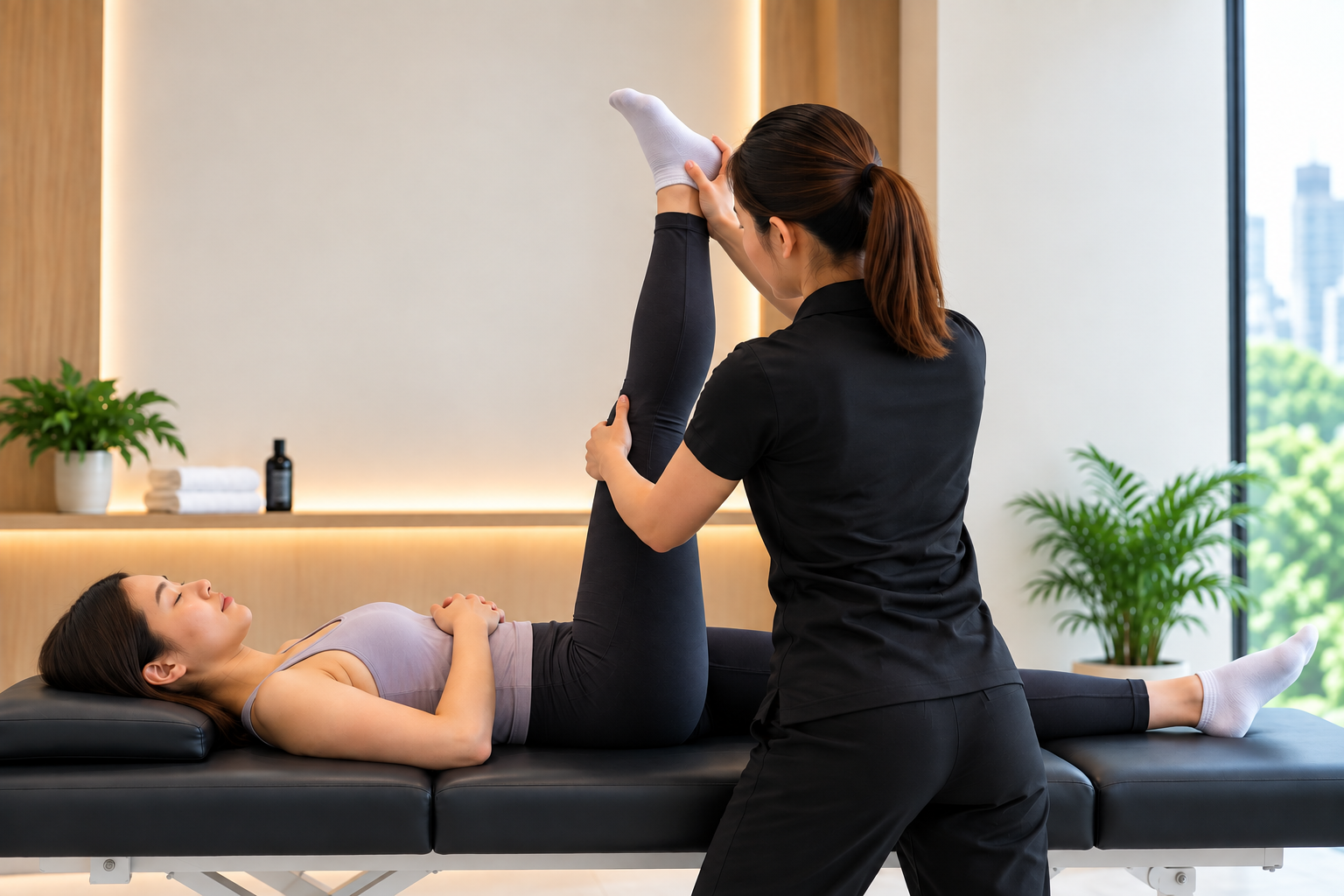
You don’t have to be an athlete to notice that your body doesn’t move quite as easily as it used to.
Maybe your hips feel tight after sitting at your desk all day. Perhaps reaching overhead feels less comfortable than it once did. Or you exercise regularly but notice that certain positions are harder to get into.
If you’ve tried stretching on your own but find some areas difficult to reach or work on, stretch therapy may be another option to explore.
At its simplest, stretch therapy is guided stretching. A practitioner assists you through selected stretches and movement positions, adjusting the positioning and intensity according to your flexibility and comfort.
At NATRAHEA, Stretch Therapy involves guided assisted stretching designed to work on flexibility and mobility. The session is tailored to your individual movement needs, with the stretches and positioning adjusted according to your comfort and flexibility.
But how does it differ from sports massage? And when might physiotherapy be a more appropriate option?
Let’s take a closer look.
What Is Stretch Therapy?
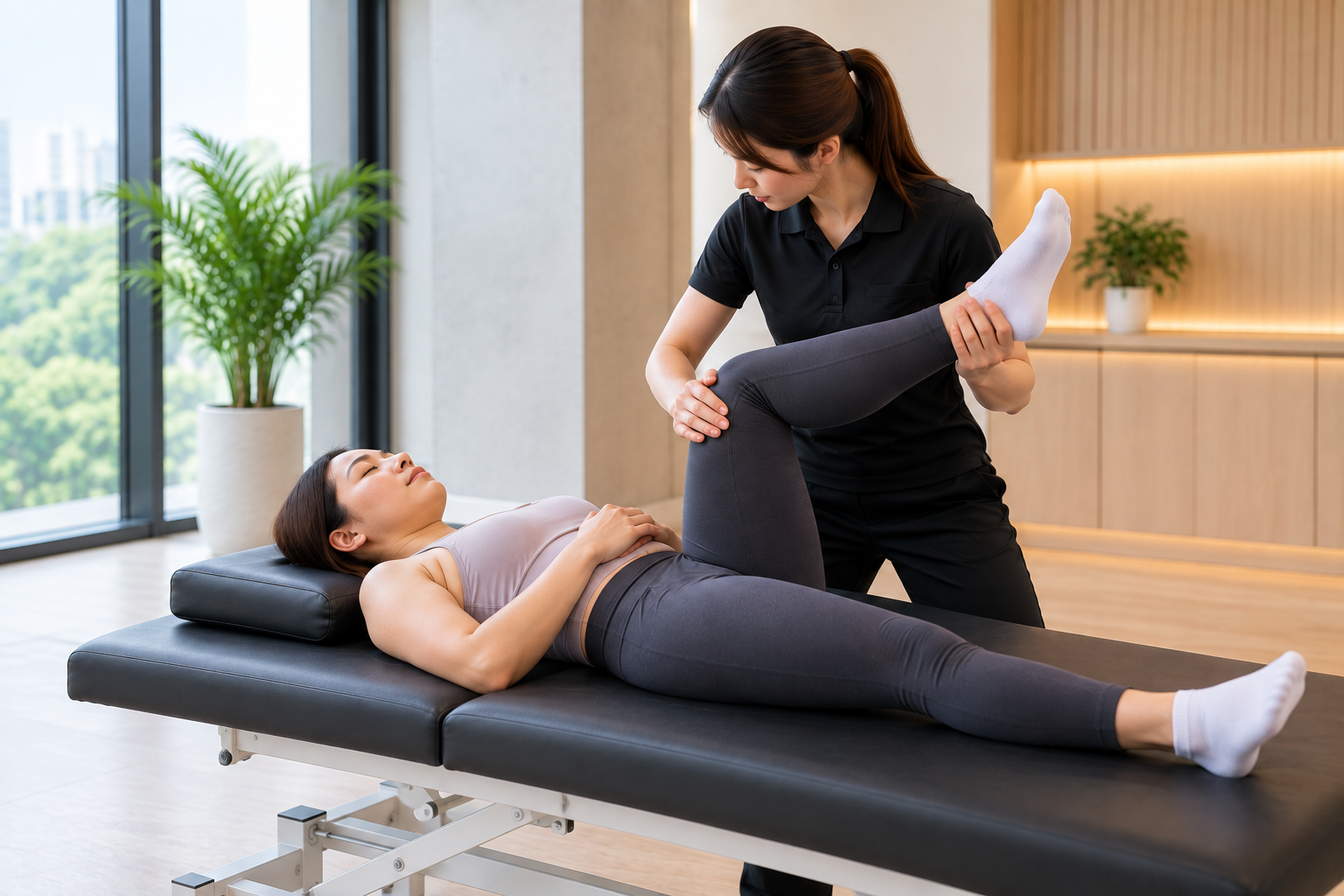
Stretch therapy is a guided approach to stretching in which a practitioner assists you through controlled stretches and movement positions.
Unlike stretching by yourself, assisted stretch therapy allows a practitioner to guide the position of your body and adjust the stretch as you move.
Depending on the session, assisted stretching can involve:
- Guided stretches
- Controlled movement through different ranges
- Contract-relax stretching techniques
- Targeted mobility work
The purpose is not simply to push a stretch as far as possible.
Instead, the session focuses on working through appropriate positions in a controlled manner.
People commonly explore stretch therapy in Singapore when they want to work on flexibility, mobility or range of motion, particularly when certain movements feel restricted.
It is also worth understanding that stretch therapy, sports massage and physiotherapy are different services. Each has a different focus, and choosing between them starts with understanding what you actually want to work on.
What Are the Benefits of Stretch Therapy?
The main areas associated with stretch therapy are flexibility, mobility and range of motion.
Stretching can be incorporated into a broader movement routine, whether you’re spending most of your day at a desk, exercising regularly or simply trying to stay mobile as you get older.
1. Working on Flexibility
Flexibility refers to how comfortably your muscles and surrounding tissues can lengthen during movement.
Your daily routine can influence how different areas of your body feel. Long periods of sitting, repetitive activities and changes in your activity levels may all affect how flexible you feel.
Assisted stretching provides a structured way to work through selected stretches while the practitioner controls the positioning and intensity.
2. Working Through Range of Motion
Range of motion describes how far a joint can move in a particular direction.
You might notice restrictions when:
- Reaching overhead
- Squatting
- Bending forward
- Rotating your body
- Moving your hips
- Extending your legs
A stretch therapy session can include controlled stretching and mobility work around these movement patterns.
The focus is on working within a suitable range rather than forcing a joint or muscle into an extreme position.
3. Working on Areas That Feel Tight or Restricted
Many people seek assisted stretching because certain areas simply don’t feel as mobile as they would like.
Common areas include:
- Hips
- Hip flexors
- Hamstrings
- Quadriceps
- Calves
- Shoulders
- Chest
- Upper back
However, “tight” does not always mean that a muscle simply needs more stretching.
Your activity level, movement habits, strength and previous experiences with exercise can all influence how an area feels.
This is one reason a guided session can be useful: instead of following the same stretching routine for everyone, the practitioner can focus on the areas that are relevant to you.
4. Supporting Everyday Mobility
Mobility is part of almost everything you do during the day.
You use it when you:
- Get out of a chair
- Walk
- Climb stairs
- Bend down
- Reach for something
- Turn your body
- Squat
- Exercise
Working on flexibility and mobility can therefore be part of maintaining a regular movement routine.
You don’t need to be training for a marathon or spending hours in the gym for mobility to matter.
5. Complementing an Active Lifestyle
Different activities place different demands on your body.
A runner may work on different movement patterns from someone who regularly performs squats or plays racquet sports.
For active adults, assisted stretching can be incorporated into a broader routine that also includes exercise, strengthening and adequate recovery.
Stretch therapy is therefore best viewed as one part of your overall approach to movement, rather than a replacement for exercise or other forms of physical care.
Stretch Therapy vs Sports Massage: What's the Difference?
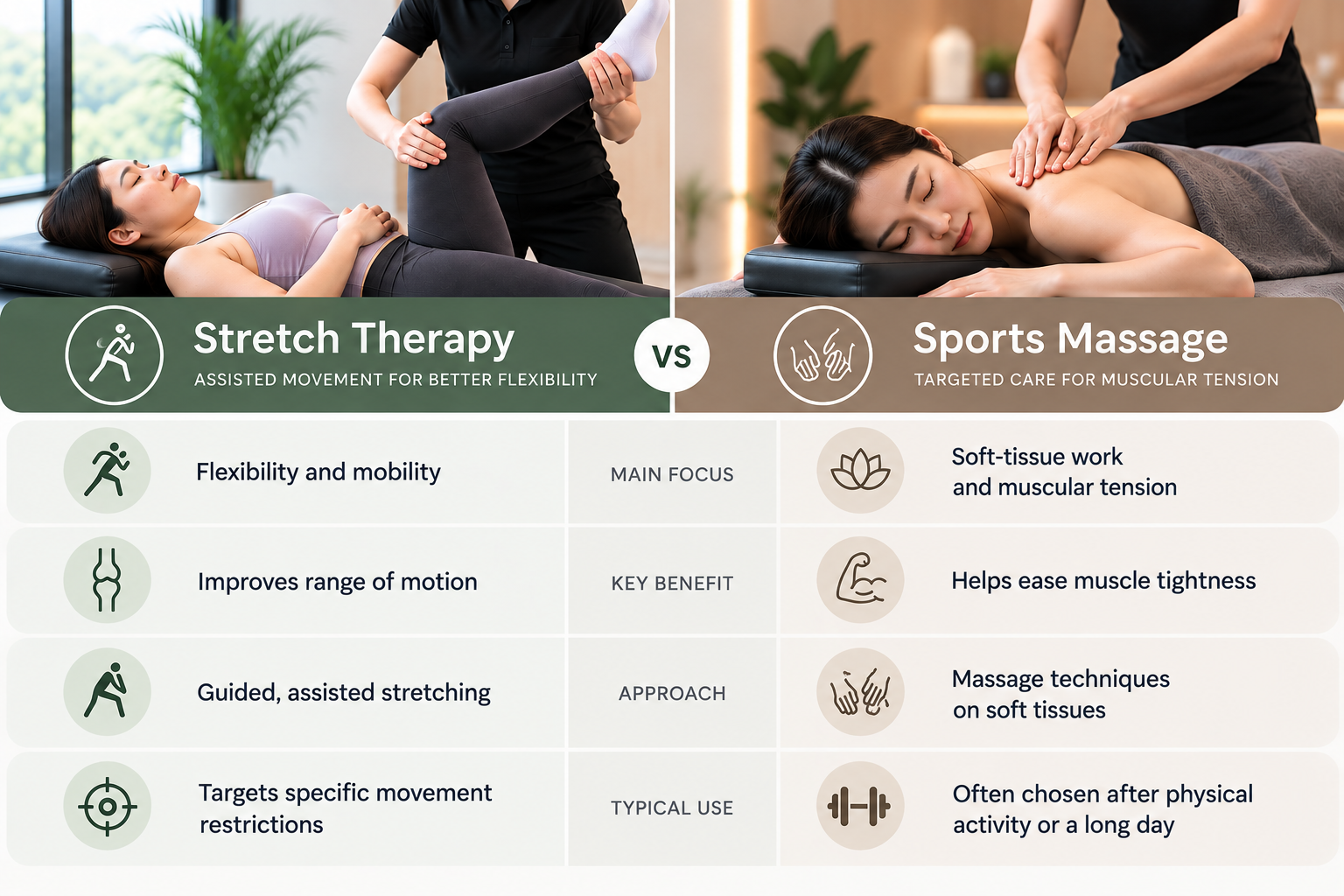
If you’re deciding between stretch therapy vs sports massage, start with what you want from the session.
Stretch therapy focuses primarily on assisted stretching, flexibility and mobility.
Sports massage focuses more on massage and soft-tissue techniques, and is commonly chosen by people looking for muscular relaxation or soft-tissue work around physical activity.
Neither is automatically better.
They simply approach the body differently.
| Stretch Therapy | Sports Massage | |
|---|---|---|
Primary focus | Flexibility, mobility and range of motion | Soft-tissue work and muscular tension |
Typical approach | Assisted stretching and controlled movement | Massage and soft-tissue techniques |
Client participation | You may actively participate in some stretches | Usually more passive |
Movement component | Central to the session | Usually secondary |
Common reason for choosing it | Working on flexibility or mobility | Relaxation or muscular tension |
Which Should You Choose?
The choice between stretch therapy and sports massage largely comes down to what you want to focus on during your session.
If your priority is working on flexibility, mobility or range of motion, assisted stretching may be the more suitable option.
If you’re primarily looking for massage and soft-tissue work, particularly after physical activity or a long day, sports massage may be more appropriate.
Both approaches have their place. The key is choosing the one that best matches what you want to work on.
Stretch Therapy vs Massage for Muscle Tightness
The word “tight” can mean different things to different people.
You might describe your shoulders as tight because they feel tense after a long day at your computer.
Someone else might describe their hips as tight because certain positions feel difficult to get into.
These are not necessarily the same experience.
If your main goal is relaxation and soft-tissue work, massage may be more relevant.
If you’re specifically looking to work on flexibility, mobility or a particular range of motion, assisted stretching may be more relevant.
The important thing is not to assume that every feeling of tightness has the same cause.
If discomfort persists, becomes significant or is accompanied by symptoms such as numbness, tingling or weakness, it is better to seek an appropriate professional assessment rather than simply stretching the area more.
Assisted Stretching vs Stretching by Yourself
You may be wondering:
Why have assisted stretch therapy when you can stretch at home?
The answer is that both can have a place in your routine.
Self-Stretching
Self-stretching is convenient.
You can incorporate it into your day without an appointment, making it useful for maintaining a regular mobility routine.
You also control the position, duration and intensity yourself.
The challenge is that some positions are difficult to perform alone, particularly when you are trying to target a specific area.
Assisted Stretching
With assisted stretching, a practitioner helps position and guide your body through selected stretches.
This provides another set of eyes — and another pair of hands — to help with positioning.
The practitioner can adjust the stretch according to your flexibility and comfort, while you can focus on relaxing into or participating in the movement as required.
The goal isn’t to see how far you can be pushed.
A controlled stretch that you can tolerate comfortably is more useful than forcing yourself into the deepest possible position.
Stretch Therapy and Lower Back Stiffness
Some people searching for stretch therapy in Singapore are interested in working on stiffness around the lower back, hips or legs.
If your lower back feels stiff, however, it can be useful to look beyond the area that feels uncomfortable.
The hips, hamstrings, hip flexors, glutes and upper back all contribute to how your body moves.
That does not mean that stretching these areas will automatically resolve a back problem. It simply means that movement is not always isolated to the place where you notice the sensation.
At NATRAHEA, the focus of Stretch Therapy is on understanding the movement and flexibility areas you want to work on and guiding you through appropriate assisted stretches.
If you have persistent or significant pain, a recent injury, swelling, numbness, tingling, weakness or a sudden change in movement, seek an appropriate healthcare assessment rather than assuming that stretching is the answer.
Stretch Therapy and Neck & Shoulder Stiffness
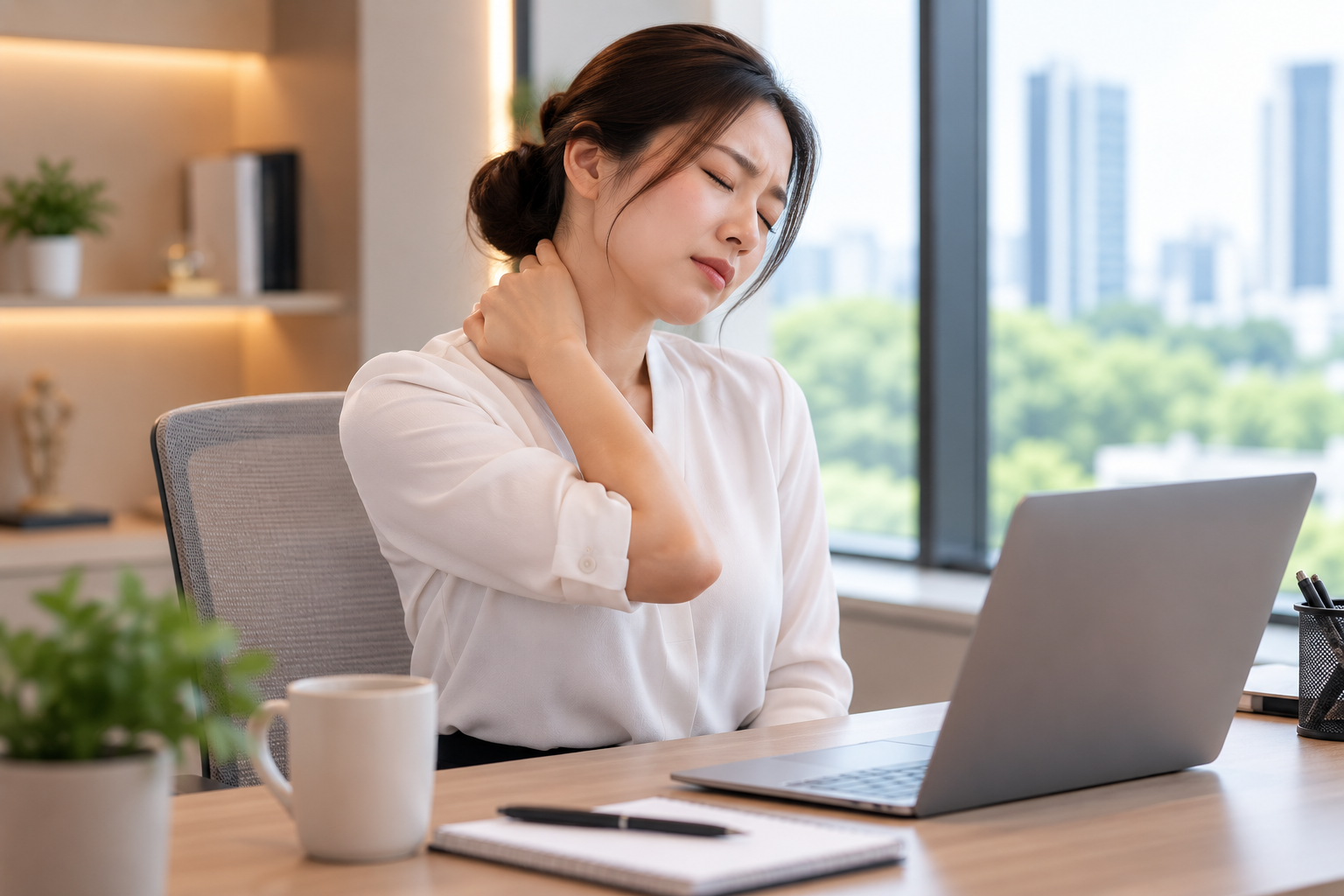
For people who spend much of the day at a computer, the neck and shoulders can be areas that feel particularly restricted.
A stretch therapy session can include controlled movement involving areas such as:
- Neck
- Shoulders
- Chest
- Upper back
- Arms
However, how your neck and shoulders feel can be influenced by more than flexibility alone.
Your workstation setup, daily movement, exercise routine and strength can all form part of the bigger picture.
This is why stretching is best viewed as one component of a broader movement routine rather than a universal answer for every type of neck or shoulder complaint.
Stretch Therapy for Gym-Goers, Runners and Active Adults
Stretch therapy isn’t only for people who spend their working day at a desk.
If you regularly exercise, you may also want to include assisted stretching as part of your mobility routine.
This can be relevant to:
- Gym-goers
- Runners
- Cyclists
- Racquet-sport players
- Football players
- Recreational athletes
Different activities have different movement requirements.
Someone who regularly performs deep squats may want to work on different areas from someone whose main activity is running.
A guided session can therefore focus on the flexibility and mobility areas that are relevant to how you move.
It should complement — rather than replace — your regular exercise, strengthening and recovery routine.
What Happens During a Stretch Therapy Session at NATRAHEA?
If you’ve never tried stretch therapy in Singapore, you may be wondering what actually happens during the session.
At NATRAHEA, the session starts by understanding what you want to work on and which areas feel restricted.
From there, your practitioner guides you through selected assisted stretches, adjusting the positioning and intensity according to your flexibility and comfort.
1. Initial Discussion
Your practitioner discusses your lifestyle, activity levels, movement goals and the areas you would like to focus on.
This gives the session some context rather than starting with a standard stretching routine.
2. Movement and Flexibility Check
Your movement and flexibility are considered to identify areas that may be appropriate for targeted mobility work.
The purpose is to understand how you move so the session can be adapted accordingly.
3. Assisted Stretching
Your practitioner guides different parts of your body through selected stretching positions.
Depending on the stretch, you may relax into the position or actively participate.
4. Targeted Mobility Work
Particular areas can receive more attention based on your movement and flexibility needs.
The intensity is adjusted according to your comfort.
5. Guidance for Between Sessions
Where appropriate, your practitioner may suggest simple stretches or mobility movements that you can incorporate into your routine.
This helps make mobility something you can continue working on outside the session.
Does Stretch Therapy Hurt?
Stretch therapy should not be forced through sharp pain.
It is normal to notice tension when a muscle is being stretched, particularly around an area that feels less flexible.
Sharp pain or intense discomfort, however, should not be treated as a sign that the stretch is more effective.
Tell your practitioner how the stretch feels so that the position or intensity can be adjusted.
The goal is not to stretch as far as humanly possible.
The goal is to work through movement in a controlled and comfortable way.
How Often Should You Have Stretch Therapy?
There isn’t one schedule that works for everyone.
How often you have assisted stretching can depend on:
- Your mobility goals
- Current flexibility
- Activity levels
- Exercise routine
- The areas you want to work on
- How you respond to stretching
If you’re working on flexibility, regular mobility work is generally more practical than occasionally trying to push yourself through an intense stretching session.
You can also combine assisted sessions with simple mobility work at home.
Who May Consider Stretch Therapy?
You don’t need to be an athlete to explore stretch therapy in Singapore.
It may be relevant if you:
- Spend long hours sitting at a desk
- Regularly feel stiff
- Exercise frequently
- Want to work on flexibility
- Want to incorporate more mobility work into your routine
- Want guided assistance rather than stretching entirely on your own
- Want to maintain mobility as you get older
At the same time, stretch therapy isn’t the right starting point for every situation.
If you have significant or persistent pain, a recent injury, swelling, numbness, tingling, weakness or an unexplained change in movement, consider an appropriate healthcare assessment before beginning assisted stretching.
Stretch Therapy vs Physiotherapy
Stretch Therapy and physiotherapy have different roles.
Stretch Therapy focuses primarily on assisted stretching, flexibility and mobility.
Physiotherapy takes a broader approach to physical function and can involve assessment, therapeutic exercise, rehabilitation and other interventions depending on the individual’s needs.
If you’re mainly looking to work on flexibility or incorporate assisted stretching into your routine, Stretch Therapy may be worth exploring.
If you’re recovering from an injury or experiencing a significant limitation in movement or physical function, physiotherapy may be a more appropriate starting point.
NATRAHEA also provides Physiotherapy for people who require a broader approach to movement and physical function.
How Stretch Therapy Fits Into a Broader Approach to Movement
Stretch therapy is one way to work on flexibility and mobility.
Depending on what you’re looking for, you may also come across services such as sports massage, physiotherapy and exercise-based mobility training.
These approaches can overlap in some areas, but they are not interchangeable.
| Approach | Primary Focus | Typical Approach |
|---|---|---|
Stretch Therapy | Flexibility and mobility | Assisted stretching and controlled movement |
Sports Massage | Soft tissues and muscular tension | Massage and soft-tissue techniques |
Physiotherapy | Movement and physical function | Assessment, exercise and rehabilitation approaches |
Exercise & Mobility Training | Strength, movement and physical capacity | Regular exercise, strengthening and mobility work |
The right choice starts with understanding what you want to work on.
Why Choose NATRAHEA for Stretch Therapy in Singapore?
At NATRAHEA, Stretch Therapy is built around guided assisted stretching and targeted mobility work.
Rather than asking you to follow a standard stretching routine, the session can be adapted around the areas you want to work on, your flexibility and how comfortably you move through different positions.
That means the session isn’t simply about “stretching more.”
It is about using guided stretching to work on the mobility areas that matter to you.
NATRAHEA’s wider approach also means that Stretch Therapy is not the only movement-focused service available. Where appropriate, you can explore NATRAHEA Physiotherapy when your needs call for a broader approach to physical function or rehabilitation.
If you’re unsure which service makes sense for you, the best starting point is to explain what you’re experiencing and what you want to achieve.
Stretch Therapy vs Sports Massage: Which Should You Choose?
Still deciding between stretch therapy vs sports massage?
Think about what you want from the session.
If you’re experiencing persistent, severe or unusual symptoms, don’t assume that either stretching or massage is the right solution. Consider an appropriate professional assessment first.
When Should You Seek Professional Assessment?
Stretching is not appropriate for every situation.
Consider seeking an appropriate healthcare assessment if you experience:
- Significant or persistent pain
- A recent injury
- Swelling
- Numbness
- Tingling
- Weakness
- A sudden change in movement
- Unexplained or worsening symptoms
These symptoms should not simply be assumed to be the result of muscle tightness.
An appropriate professional can help determine what type of assessment or care may be suitable.
Making Mobility Part of Your Routine
You don’t have to be an athlete to care about mobility.
It matters when you reach for something on a high shelf, get out of a chair, climb stairs, exercise or simply move through your day.
If you already have a stretching routine that works for you, keep doing it.
But if you find certain areas difficult to stretch on your own, guided assisted stretching can provide another way to work on flexibility and mobility.
At NATRAHEA, Stretch Therapy is designed around your movement and flexibility needs, with assisted stretches guided by a practitioner throughout the session.
The goal isn’t to stretch as far as possible. It’s to move with greater ease, confidence and control.
Frequently Asked Questions
1. What is stretch therapy?
Stretch therapy is a guided approach to stretching in which a practitioner assists your body through controlled stretching and movement positions. It primarily focuses on flexibility, mobility and range of motion.
2. What is assisted stretch therapy?
Assisted stretch therapy involves a practitioner helping position and guide parts of your body through selected stretches. This allows particular muscle groups and movement ranges to be worked on while the intensity is adjusted according to your comfort.
3. What is the difference between stretch therapy and sports massage?
Stretch therapy primarily focuses on assisted stretching, flexibility and mobility, while sports massage uses massage and soft-tissue techniques. The better fit depends on what you want to focus on.
4. Is stretch therapy better than massage for tight muscles?
Neither is universally better. If your main goal is flexibility and mobility, stretch therapy may be more relevant. If your main goal is relaxation or soft-tissue work, massage may be more appropriate.
5. What are the benefits of stretch therapy?
Stretch therapy focuses on flexibility, mobility and range of motion. It can form part of a broader movement routine for people who want guided assistance with stretching.
6. Is assisted stretching better than stretching by yourself?
Not necessarily. Self-stretching is convenient and can become part of your regular routine. Assisted stretching provides practitioner guidance and can make certain positions easier to work on.
7. Can stretch therapy help with stiffness?
Stretch therapy can be used to work on flexibility and mobility when certain areas feel stiff or restricted. However, stiffness can have different contributing factors, so it should not automatically be assumed that more stretching is the answer.
8. Is stretch therapy suitable for office workers?
Office workers who spend long periods sitting may find assisted stretching useful as part of a broader mobility routine. Regular movement, exercise and a suitable workstation setup are also important parts of staying active.
9. Is stretch therapy suitable for athletes?
Yes, assisted stretching can form part of a flexibility and mobility routine for active individuals. The areas worked on can vary depending on the activity and movement requirements.
10. How often should I have stretch therapy?
There is no universal schedule. It depends on your mobility goals, activity levels, flexibility and how your body responds. Regular mobility work is generally more practical than occasional aggressive stretching.
11. What should I wear for stretch therapy?
Wear comfortable clothing that allows you to move freely through different stretching positions.
12. Is stretch therapy the same as physiotherapy?
No. Stretch therapy primarily focuses on assisted stretching and mobility, while physiotherapy takes a broader approach to physical function and can include assessment, exercise therapy and rehabilitation.
13. Where can I find stretch therapy in Singapore?
When choosing a stretch therapy provider, look for a service that considers your individual flexibility and mobility rather than applying exactly the same routine to everyone.
NATRAHEA offers guided Stretch Therapy focused on assisted stretching and mobility. If you’re unsure whether it is the right option for you, discuss your goals and circumstances with the team before proceeding.
About This Article
This article is intended for general educational purposes. It is not a diagnosis or a substitute for individual professional assessment.
Testimonials

Our Patient Testimonials

*Staff here where all friendly and give you warm welcome, very accomodating and will notify you on the incoming schedule you make.
Thanks NATRAHEA Kovan🙏🙌🏻
NATRAHEA Clinic Locations in Singapore
Awards & Features


