
Sciatica and Sleeping: How to Sleep More Comfortably When You Have Leg and Lower Back Pain
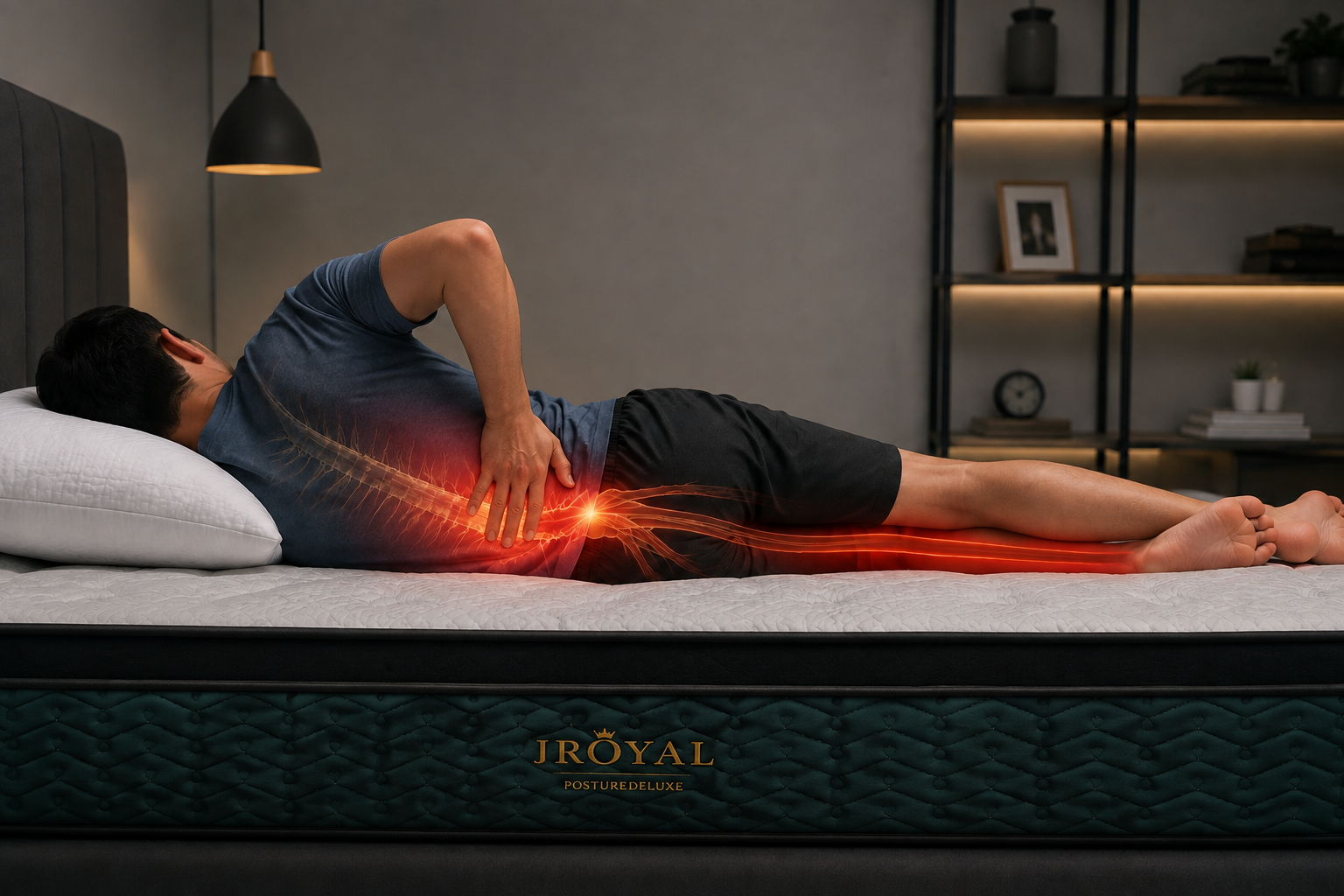
If sciatica is making it difficult to sleep, finding a comfortable sleeping position can become an important part of managing your day-to-day comfort. Pain that travels from the lower back or buttock into the leg may make it uncomfortable to lie down, turn over or remain in one position for long. For some people, symptoms may become more noticeable when lying down, during sleep or after waking up.
There is no single best sleeping position for sciatica that works for everyone. A position that feels comfortable for one person may aggravate symptoms for another. In general, the aim is to find a position that feels supportive, does not worsen your symptoms and allows you to change position when needed.
Your sleeping position is only one part of the overall sleep setup. The mattress underneath you provides the main supporting surface for your body, while pillows can be used to make smaller adjustments to your position. Choosing a mattress that feels supportive and comfortable for your usual sleeping position may therefore be worth considering when you experience lower back or leg discomfort.
This guide covers sleeping with sciatica, sleeping positions you can try, what to consider when choosing a mattress for sciatica, and when persistent or worsening symptoms may require professional assessment. We will also look at how NATRAHEA’s Posturepedic mattress range fits into a more comfortable sleep setup.
What Is Sciatica?
Sciatica refers to pain associated with irritation or compression of the sciatic nerve or one of the nerve roots that contribute to it. The sciatic nerve travels from the lower back through the buttocks and down the leg.
Typical symptoms can include:
- Pain travelling from the lower back or buttock into the leg
- Sharp, burning or shooting pain
- Tingling or pins and needles
- Numbness
- Weakness in the affected leg
Sciatica commonly affects one side of the body. Causes can include a herniated disc, narrowing of the spinal canal, changes affecting the spine or an injury.
It is also important to distinguish sciatica from ordinary lower back pain. Having back pain alone does not necessarily mean you have sciatica. Sciatica generally involves symptoms affecting the buttock and/or leg as a result of nerve irritation or compression.
Why Can Sciatica Feel Worse When Sleeping or After Waking Up?
There is not necessarily a single reason why someone with sciatica may experience more discomfort when sleeping or after waking up.
When you lie down, your body is positioned differently from when you are standing or moving during the day. Staying in one position for a prolonged period may also make certain symptoms more noticeable. For some people, discomfort may be most noticeable when getting into bed, changing position during sleep, or getting up in the morning.
Your sleeping position, mattress, daily activity, and the underlying cause of your symptoms may all influence how comfortable you feel. This is why there is no single sleeping position or sleep setup that works for everyone.
You may also notice pain more when you are trying to sleep because there are fewer daytime activities competing for your attention.
Importantly, pain that is genuinely worsening at night or repeatedly waking you should not simply be assumed to be ordinary sciatica. Persistent or unexplained night pain can sometimes require medical assessment, particularly when accompanied by other symptoms.
Does Your Sleeping Position Matter for Sciatica?
Your sleeping position can affect how comfortable your lower back, hips and legs feel while you rest. If you notice that a particular position makes your symptoms worse, try changing position rather than staying in the same posture for a prolonged period.
There is no single sciatica sleeping position that suits everyone. Some people may find side sleeping more comfortable, while others may prefer lying on their back. Your symptoms, usual sleeping position, body shape and overall comfort can all influence which position feels most suitable for you.
The goal is not to find a perfect sleeping position, but to create a comfortable setup that allows you to rest without unnecessarily aggravating your symptoms. Pillows can also be used to provide additional support where needed, such as between the knees when side sleeping or underneath the knees when lying on your back.
If you become uncomfortable during the night, changing position is generally preferable to forcing yourself to remain in a position that aggravates your symptoms. Outside of sleep, staying reasonably active and avoiding prolonged periods of bed rest are also generally recommended for managing uncomplicated sciatica.
Sleeping Positions That May Be More Comfortable With Sciatica
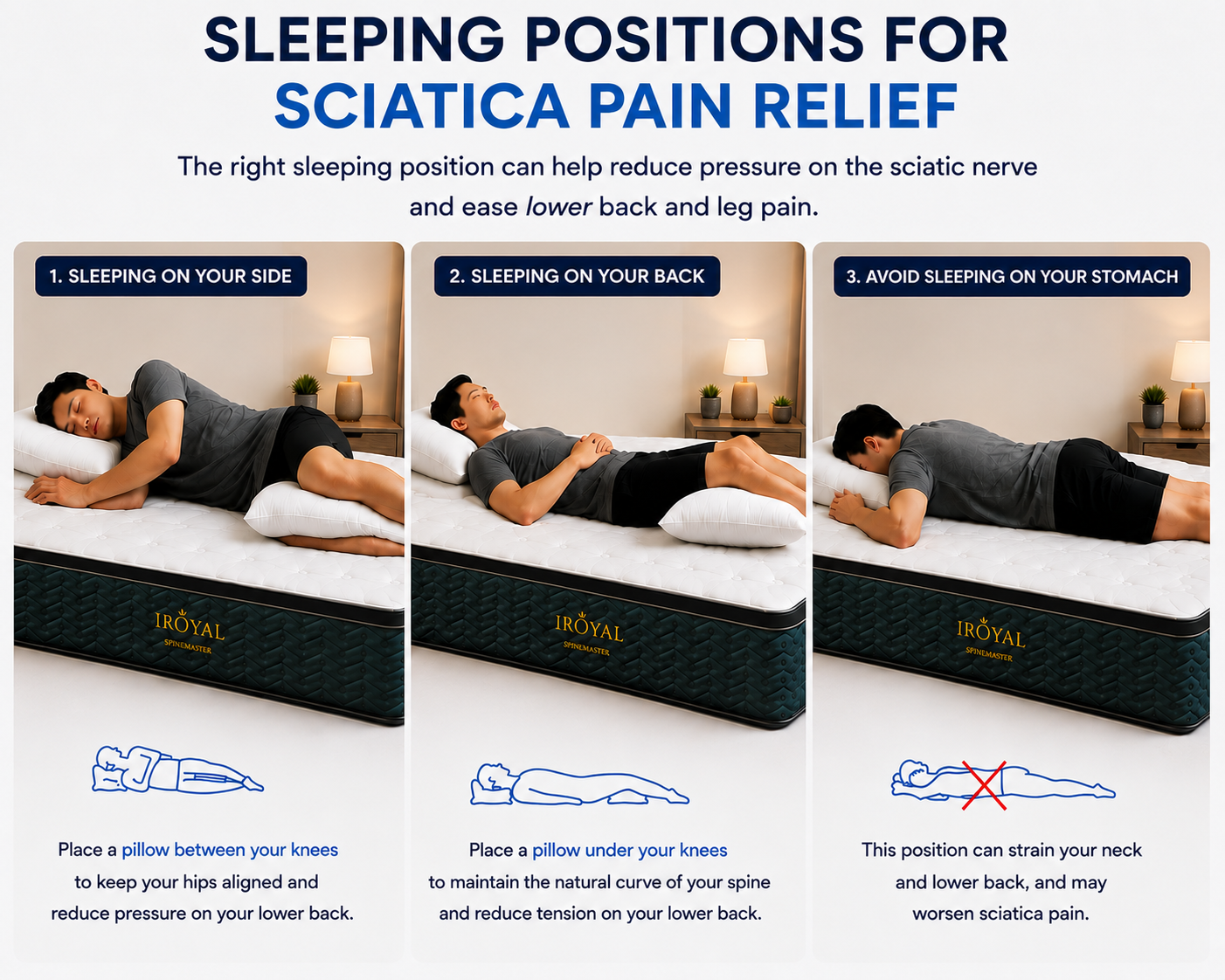
Different sleeping positions may feel more comfortable depending on your symptoms and usual sleeping habits. The following positions are worth trying to see which feels most supportive for you.
1. Sleeping on Your Side
Side sleeping can be comfortable for people who find lying on their back uncomfortable.
Try:
- Lying on the less painful side if one side is more comfortable
- Keeping your knees slightly bent rather than tightly curled
- Placing a pillow between your knees
- Keeping your head and neck comfortably supported
A pillow between the knees may make side sleeping more comfortable by supporting the legs and reducing unwanted twisting of the pelvis.
You do not need to force yourself to sleep on a particular side. If one side consistently makes your leg symptoms worse, try the other side or another position.
2. Sleeping on Your Back With Support Under the Knees
Back sleeping may feel more comfortable for some people with sciatica, particularly when the legs are gently supported. Try placing a pillow under your knees while keeping your head and neck comfortably supported. This can provide additional support for the legs and may make it easier to settle into a comfortable resting position.
If this position feels comfortable and does not aggravate your symptoms, it can be one option to consider when sleeping with sciatica. If you find that lying on your back increases your discomfort, try another position instead.
3. Sleeping on Your Front
Sleeping on your stomach is not automatically harmful, but it may not be comfortable for everyone with lower back or leg symptoms.
If this is your usual sleeping position and other positions feel worse, you may experiment with a small amount of support under the lower abdomen or hips.
However, avoid forcing a position simply because it is recommended online. If sleeping on your stomach consistently increases your symptoms, choose a different position.
The aim is comfort and symptom management, not achieving a perfectly rigid sleeping posture.
What Should You Look for in a Mattress for Sciatica?
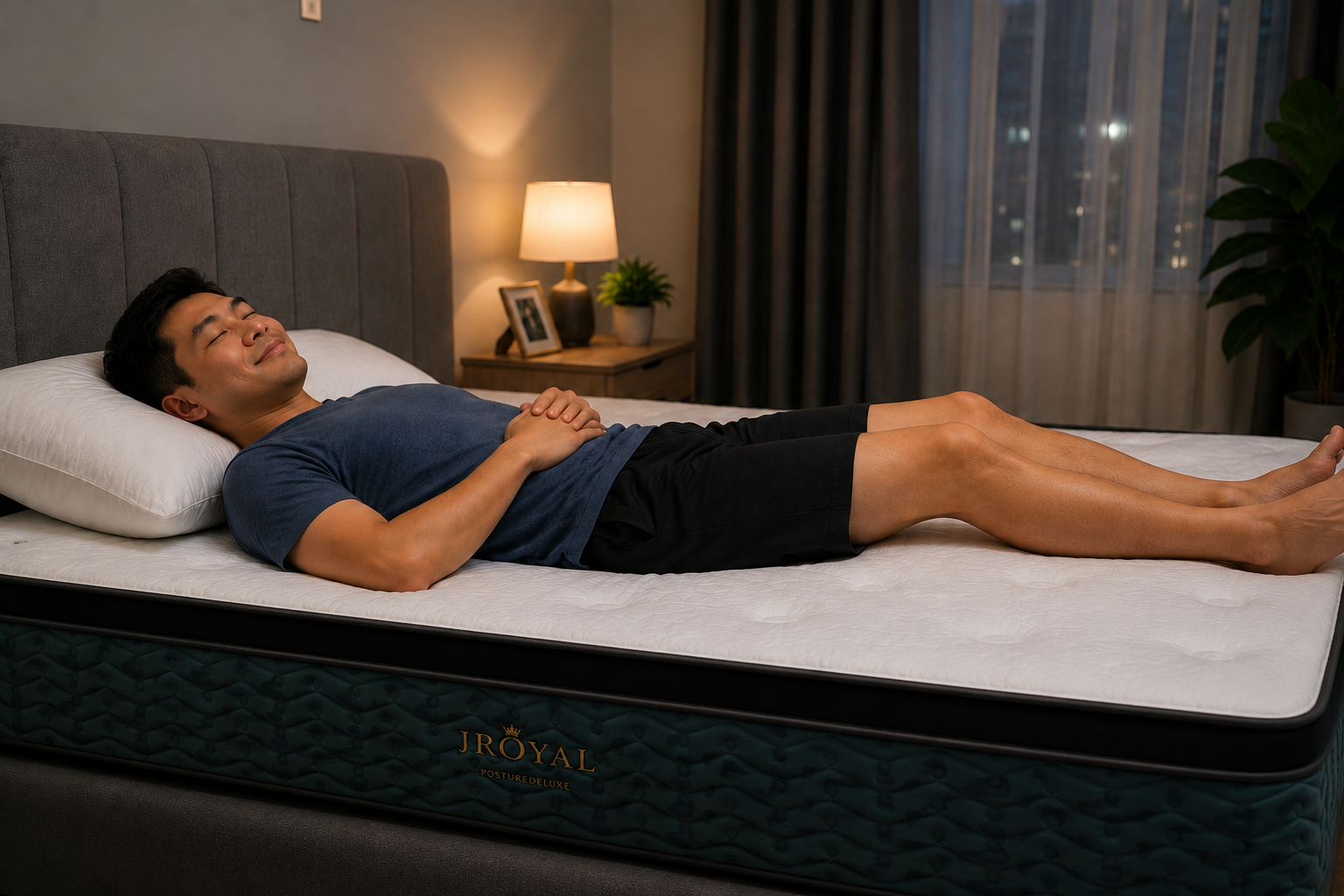
When you’re dealing with sciatica, your sleeping surface is worth considering alongside your sleeping position. A mattress that feels too soft, too firm or uncomfortable for your body may make it harder to settle into a position that feels supportive.
If your mattress allows your body to sink excessively, you may find it difficult to change position. On the other hand, a surface that feels excessively hard may create uncomfortable pressure around areas such as the shoulders, hips or pelvis.
This is why choosing a mattress for sciatica should be approached as a comfort and support decision rather than looking for a mattress that claims to cure sciatica.
Key factors to consider include:
- Adequate support
The mattress should provide enough support for your body without making you feel as though you are sinking excessively into the surface.
- Pressure distribution
Areas such as the shoulders and hips can experience pressure when you sleep on your side. A mattress that accommodates your body shape may feel more comfortable.
- Ease of movement
If turning over is difficult because you sink deeply into the mattress, the sleeping surface may not be a good personal fit.
- Temperature and breathability
Singapore’s warm and humid climate can make nighttime comfort more challenging. A sleeping surface with suitable cooling or breathable materials may be preferable if you tend to sleep hot.
- Individual Comfort and Sleeping Preferences
The right mattress for you depends on how you sleep and what feels comfortable for your body. Factors such as your usual sleeping position, body shape, preferred firmness and individual comfort can all influence how well a mattress suits you. While firmer mattresses may be recommended in some guidance for lower back pain, mattress firmness alone should not be considered a treatment for sciatica. Instead, focus on finding a mattress that provides a comfortable and supportive sleep surface for your individual needs.
Matching Your Mattress to Your Sleeping Position
| Sleeping position | What to consider | How the mattress fits into the setup |
|---|---|---|
Side sleeping | Hip and shoulder comfort; stable support | Look for a mattress that provides support while accommodating pressure around the shoulders and hips |
Back sleeping | Comfortable support across the back and pelvis | A supportive sleep surface may help you maintain a comfortable position without excessive sinking |
Stomach sleeping | May feel uncomfortable for some people with back symptoms | Focus on overall comfort and consider changing position if this position aggravates symptoms |
How NATRAHEA's Mattress Fits Into a Comfortable Sleep Environment
| Mattress Type | Best For | Sleep Feel | Support Level | Lifestyle | Great Support For |
|---|---|---|---|---|---|
SpineRest Posturepedic Mattress 10” | Essential everyday spinal alignment and posture support | Stable, medium-firm comfort with balanced cushioning | Reliable ergonomic back support for daily sleep | Practical everyday sleep solution for modern living |
|
SpinePro Posturepedic Mattress 12” | Advanced posture support with enhanced pressure relief | Adaptive comfort with balanced contouring and support | Medium-firm enhanced orthopedic support system | Balanced sleep wellness lifestyle for active individuals and couples |
|
SpineMaster Posturepedic Mattress 14” | Premium luxury posture correction and restorative sleep recovery | Deep contouring comfort with plush premium feel | Advanced multi-zone spinal support with maximum pressure relief | Luxury sleep wellness lifestyle with premium sleep comfort |
|
For people who are considering their sleeping environment as part of their overall approach to spinal comfort, NATRAHEA’s Range of Posturepedic Mattresses is designed around ergonomic support and sleep comfort.
The SpineMaster uses individually pocketed springs and a multi-zone support system designed to provide different levels of support across the body. It also features high-density memory foam that conforms to the body’s contours, while the 14-inch model incorporates NATRAHEA’s SpineGuard System. These features are designed with key pressure areas, including the shoulders, hips and lower back, in mind.
If you are choosing a mattress as part of your sleep and posture setup, these design features may be worth considering alongside your usual sleeping position and personal comfort preferences.
However, it is important to keep expectations realistic: a mattress is not a substitute for assessment or treatment of an underlying spinal or nerve condition. Its role is primarily to provide a supportive and comfortable sleeping environment.
How Can the NATRAHEA’s Range of Posturepedic Mattresses Support a More Comfortable Sleep Setup?
If you’re looking for a mattress for sciatica, the goal should not be to find a mattress that claims to treat the condition. Instead, consider whether the mattress provides the level of support and comfort you need in your usual sleeping position.
At NATRAHEA, our range of Posturepedic Mattresses is designed with a multi-zone support system and individually pocketed springs to provide structured support across different areas of the body. The mattress is also available in different thickness options, allowing sleepers to choose according to their preferred setup and requirements.
For someone who experiences lower back or leg discomfort at night, these design considerations may be relevant when creating a more supportive sleeping environment. A mattress that feels comfortable can make it easier to maintain a preferred sleeping position and move when you need to change position during the night.
However, NATRAHEA’s range of Posturepedic mattresses should be viewed as part of a comfortable sleep environment, not as a treatment or cure for sciatica. If pain, numbness, weakness or other symptoms persist, appropriate professional assessment remains important.
Find a Mattress That Fits Your Sleep Setup
A comfortable sleeping position is only one part of creating a supportive sleep environment. Your mattress also plays an important role in how your body feels while resting.
Explore NATRAHEA’s range of Posturepedic mattresses to learn more about the available support and comfort features and find an option that suits your preferred sleeping position and
Should You Stay in Bed When Sciatica Hurts?
Usually, prolonged bed rest is not recommended simply because movement is uncomfortable.
It can be tempting to remain completely still when your leg or lower back hurts, especially after a difficult night. However, current guidance encourages people with uncomplicated sciatica to maintain normal activities as much as reasonably possible and avoid prolonged periods of sitting or lying down.
This does not mean you should ignore severe pain or force yourself through activities that clearly worsen your symptoms.
Instead, consider:
- Changing position regularly
- Taking short, comfortable walks if tolerated
- Avoiding long periods in one position
- Using a comfortable sleeping setup
- Returning gradually to normal activities
- Seeking professional advice if symptoms persist or worsen
The objective is to balance rest with appropriate movement.
What About Chiropractic Care for Sciatica?
When sciatica symptoms are interfering with everyday life or sleep, understanding the underlying musculoskeletal factors can be useful.
Chiropractic care may form part of a broader approach to musculoskeletal care for some individuals, but treatment should be based on an appropriate assessment rather than the assumption that every case of leg pain requires the same intervention.
At NATRAHEA, our approach to musculoskeletal care focuses on understanding the individual’s presentation and considering appropriate options rather than treating a symptom in isolation.
For someone experiencing persistent lower back and leg symptoms, an assessment can help determine whether the symptoms are appropriate for conservative care or whether further medical evaluation may be needed.
NICE guidance recommends a personalised approach to low back pain and sciatica, with management based on the individual’s needs and clinical presentation.
When Should You Seek Professional Assessment for Sciatica?
Occasional discomfort does not necessarily indicate a serious problem. However, you should consider professional assessment if:
- Your symptoms are getting worse
- Pain is interfering significantly with sleep or normal activities
- Symptoms continue despite reasonable self-management
- You develop persistent numbness or tingling
- You notice weakness in the leg
- Pain repeatedly wakes you at night
- Your symptoms follow a significant injury
- You have unexplained weight loss or fever alongside back pain
Singapore healthcare guidance advises medical assessment for back pain accompanied by leg symptoms, particularly where there is weakness, numbness, worsening night pain or other concerning symptoms.
When Back or Leg Pain Continues to Affect Your Sleep
If lower back or leg discomfort continues to interfere with your sleep, daily activities or movement, changing your sleeping position or mattress may not be enough.
NATRAHEA provides chiropractic and stretch therapy services as part of its broader approach to musculoskeletal wellbeing. An appropriate assessment can help determine whether conservative care may be suitable for your individual situation.
Explore NATRAHEA’s Chiropractic & Stretch Therapy Services
If you experience significant weakness, worsening numbness, changes in bladder or bowel function, or other concerning symptoms, seek appropriate medical assessment promptly.
When Is Sciatica an Emergency?
Most cases of sciatica are not medical emergencies. However, certain symptoms require urgent assessment.
Seek emergency medical attention if you develop:
- New difficulty starting urination or inability to urinate
- New loss of bladder control
- New loss of bowel control
- Numbness around the genitals, anus or buttocks
- Severe or worsening weakness or numbness affecting both legs
- Sciatica affecting both sides together with significant neurological symptoms
These symptoms can indicate cauda equina syndrome, a rare but serious condition involving compression of nerves in the lower spine.
Do not attempt to manage these symptoms by changing your mattress, stretching or waiting for them to settle.
Common Mistakes When Sleeping With Sciatica
Mistake 1: Staying completely still
Pain can make movement feel intimidating, but prolonged lying down is generally not recommended as the main strategy for uncomplicated sciatica.
Mistake 2: Searching for one "perfect" position
There is no universal sleeping position that works for every person.
Mistake 3: Assuming a very firm mattress is always better
Mattress firmness is only one consideration. Support, pressure distribution, sleeping position and personal comfort all matter.
Mistake 4: Ignoring worsening neurological symptoms
Increasing weakness, significant numbness or changes in bladder or bowel function should not be treated as a mattress or sleeping-position problem.
Mistake 5: Treating the mattress as the treatment
A supportive mattress may improve comfort, but it does not diagnose or address the underlying cause of sciatica.
Frequently Asked Questions
1. What are sleeping positions that may be more comfortable with sciatica?
There is no single best position for everyone. Side sleeping with a pillow between the knees and back sleeping with a pillow underneath the knees are two practical positions to try. Choose the position that feels comfortable and does not aggravate your symptoms.
2. Is it better to sleep on your side or back with sciatica?
Either can be comfortable depending on the individual. Side sleeping may be easier with a pillow between the knees, while back sleeping may be more comfortable with support underneath the knees.
3. Can a mattress make sciatica worse?
A mattress may affect how comfortable you feel while sleeping. If it provides inadequate support, causes excessive sinking or creates uncomfortable pressure, you may find it harder to rest. However, a mattress should not be assumed to be the underlying cause of sciatica.
4. Is a firm mattress better for sciatica?
Not necessarily for everyone. Some healthcare guidance recommends a firm mattress for lower back pain, but individual comfort and support are important considerations.
5. Should I sleep with a pillow between my knees?
If you sleep on your side, a pillow between the knees is a practical option to try. It may make the position feel more comfortable by supporting the legs and pelvis.
6. Should I sleep with a pillow under my knees?
If you sleep on your back, placing one or two pillows beneath the knees may make the position more comfortable for some people.
7. Why is my lower back pain worse when sleeping?
Several factors may contribute, including your sleeping position, mattress comfort, the underlying cause of your pain and how long you remain in one position. Persistent or worsening night pain should be professionally assessed rather than automatically attributed to your mattress.
8. Can sleeping with sciatica affect recovery?
Poor sleep can make living with pain more difficult, while comfortable, good-quality sleep supports overall wellbeing. However, changing your sleeping position alone does not address every cause of sciatica. A broader management plan may be necessary.
9. When should I see a healthcare professional for sciatica?
Seek professional assessment if your symptoms are worsening, persistent, significantly affecting daily activities or accompanied by weakness or numbness. Seek emergency care for new bladder or bowel problems, saddle-area numbness or severe/worsening neurological symptoms affecting both legs.
Conclusion: Making Sleep More Comfortable With Sciatica
Sleeping with sciatica can be frustrating, particularly when pain travels into the leg and makes it difficult to find a comfortable position.
The good news is that small changes to your sleeping environment may make resting more manageable. Try side sleeping with a pillow between your knees or back sleeping with support underneath your knees. Pay attention to how your mattress supports your body, and avoid staying in one painful position for prolonged periods.
At NATRAHEA, we believe that comfortable sleep is one part of a broader approach to musculoskeletal wellbeing. Our range of Posturepedic Mattress is designed with ergonomic support, zonal support and pressure distribution in mind, making it one option to consider when evaluating your overall sleeping environment.
However, a mattress or sleeping position should never replace appropriate assessment when symptoms persist, worsen or involve neurological changes.
If you are looking for Sciatica Treatment Singapore, the first step is understanding what may be contributing to your symptoms and choosing an appropriate approach based on your individual needs.
Medical Disclaimer
This article is intended for general educational purposes only and does not constitute medical advice, diagnosis or treatment. Sciatica and lower back pain can have different causes, and the information that is appropriate for one person may not be appropriate for another.
If you have persistent, severe or worsening symptoms, significant weakness or numbness, or changes in bladder or bowel function, seek appropriate medical assessment promptly. In an emergency, seek immediate medical attention.
Information about NATRAHEA services and products is provided for general context and should not be interpreted as a claim that any particular service or mattress can cure or treat sciatica.
References
HealthHub Singapore – Low Back Pain
https://www.healthhub.sg/health-conditions/low-back-pain
HealthHub Singapore / Khoo Teck Puat Hospital – Herniated Disc (Slipped Disc)
https://www.healthhub.sg/health-conditions/herniated-disc-ktph
SingHealth – Low Back Pain (Spinal Care)
https://www.singhealth.com.sg/symptoms-treatments/low-back-pain-spinal-care
SingHealth – Back Pain With Leg Symptoms
https://www.singhealth.com.sg/symptoms-treatments/back-pain-with-leg-symptoms
SingHealth – Lower Back Pain – Symptoms, Prevention & Treatment
https://www.singhealth.com.sg/symptoms-treatments/lower-back-pain
SingHealth – Managing Low Back Pain in Primary Care
https://www.singhealth.com.sg/news/patient-care/managing-low-back-pain-in-primary-care
NICE – Low Back Pain and Sciatica in Over 16s: Assessment and Management (NG59)
https://www.nice.org.uk/guidance/ng59
NHS – Sciatica
https://www.nhs.uk/conditions/sciatica/
NHS – Exercises for Sciatica Problems
https://www.nhs.uk/live-well/exercise/exercises-sciatica-problems/
Cambridge University Hospitals NHS Foundation Trust – Sciatica
https://www.cuh.nhs.uk/patient-information/sciatica/
NATRAHEA – Spinemaster Posturepedic Mattress
https://natrahea.com.sg/posturepedic-mattress-spinemaster/
NATRAHEA – SpineMaster Posturepedic Mattress 14”
https://natrahea.com.sg/product/posturepedic-mattress-spinemaster-14inch/
Testimonials

Our Patient Testimonials

*Staff here where all friendly and give you warm welcome, very accomodating and will notify you on the incoming schedule you make.
Thanks NATRAHEA Kovan🙏🙌🏻
NATRAHEA Clinic Locations in Singapore
Awards & Features


